- Home
- Government
- Departments
- Public Works
- Operations and Maintenance
- Water supply and distribution
Water supply and distribution
Water quality reports
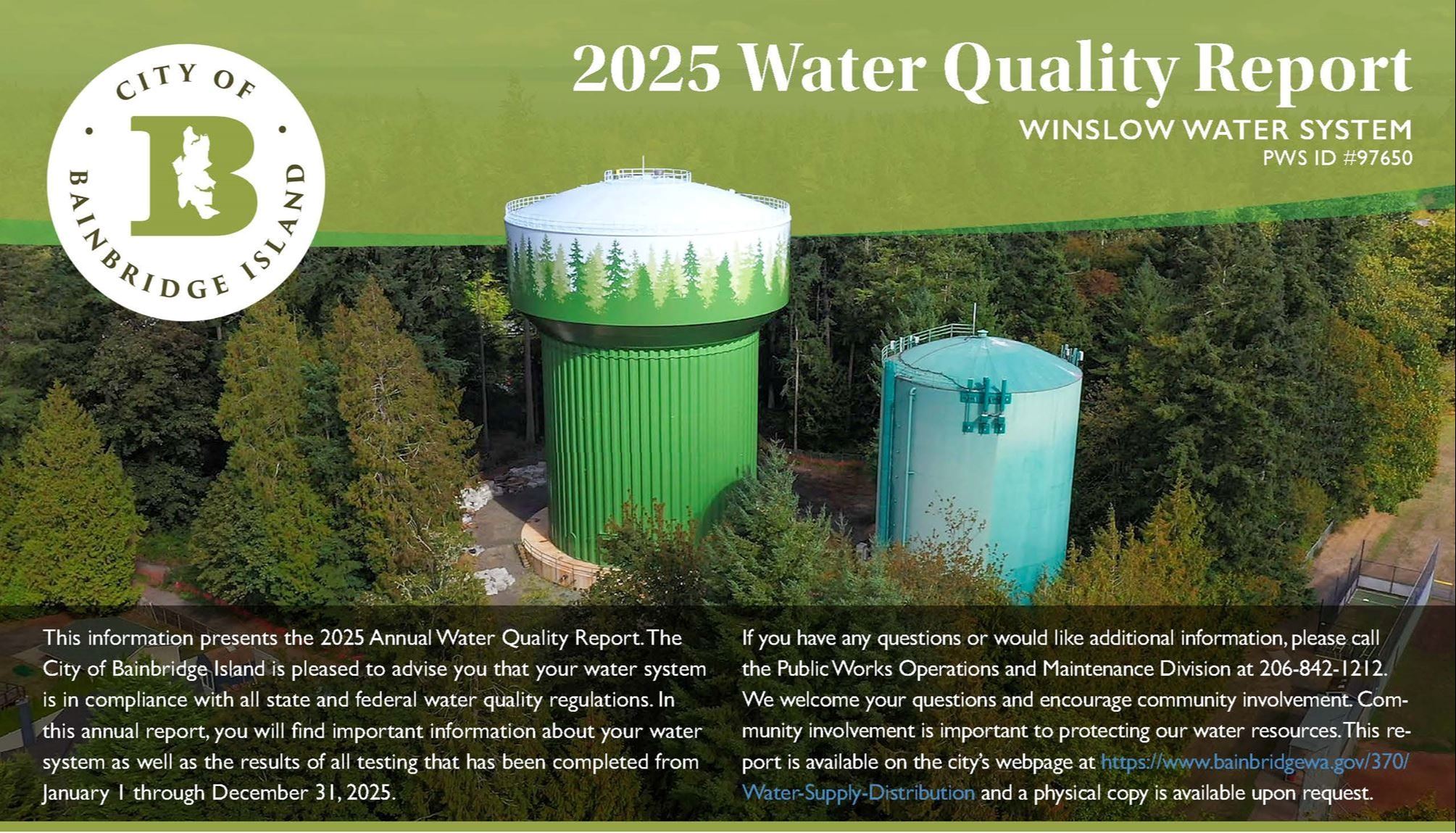
See reports below for 2025 testing:
Daily water operations
Water operations include operation and maintenance of city-owned water systems including Winslow, Rockaway Beach, and the Public Works Facility systems. The Winslow Water System serves the historic downtown Winslow and Fletcher Bay areas. Rockaway Beach Water System serves customers along Rockaway Beach Drive and the Public Works Facility serves city maintenance personnel. These systems have a combined infrastructure that includes:
Infrastructure Component | Total |
| Active Reservoirs | 4 |
| Backflow Accounts | 1,593 |
| Distribution Valves | 1000+ |
| Fire Hydrants | 832 |
| Miles of Water Main | 44 |
| Pressure Reducing Stations | 16 |
| Service Meters | 2857 |
| Supply Wells | 13 |
Treatment and quality
At each major well site, water is treated with chlorine and fluoride before being pumped into the distribution system to fill reservoirs and supply customers. An active cross-connection control program helps protect the water system from contamination and water quality is regularly monitored and tested to ensure that it meets all state and federal regulations.
Activities
Water activities supply over 200-million gallons of water annually to 6,000 customers. The water system infrastructure is monitored by telemetry 24/7. The main supply wells draw from four separate aquifers providing flexibility to meet changing conditions and future demands.
Responsibilities
Routine activities include:
- Water main line flushing
- Meter reading
- Regulatory reporting
- Sample testing
- Well monitoring
- Backflow testing
Annual water system flushing is performed at the beginning of each year to remove trace minerals, mostly iron and manganese from the water mains. Although iron and manganese do not pose health concerns, they can create aesthetic issues affecting the taste, clarity, and color of the water. This sediment is removed, and water quality maintained by unidirectional flushing of the water mains on an annual basis. Unidirectional water main flushing involves valving off each section of water main and then directing water at high flow rates through fire hydrants.
Signs will be posted in neighborhoods prior to flushing. If customers experience low water pressure or discolored water during the work, they are advised to avoid running water or doing laundry for one hour. After one hour has passed, customers should run cold water for approximately five minutes until it's clear.
On January 15, 2021, the U.S. Environmental Protection Agency (EPA) issued Lead and Copper Rule Revisions (LCRR) that went into effect on December 16, 2021. Group A Community and non-transient non-community (NTNC) water systems are required to follow the LCRR, which is located in 40 CFR 141. On November 1, 2024, EPA published the finalized Lead and Copper Rule Improvements (LCRI), which builds on the current requirements of the LCRR. The new LCRI requirements will take effect in November 2027.
What does this mean to Group A water systems?
To comply with the LCRR and LCRI, community and NTNC water systems must have developed and submitted a Lead Service Line Inventory (LSLI) to the state by October 16, 2024. City of Bainbridge Island has completed their initial LSLI. Copies can be made available upon request. Please email us at pwom@bainbridgewa.gov if you would like to receive a copy.
Water Service Line Diagram